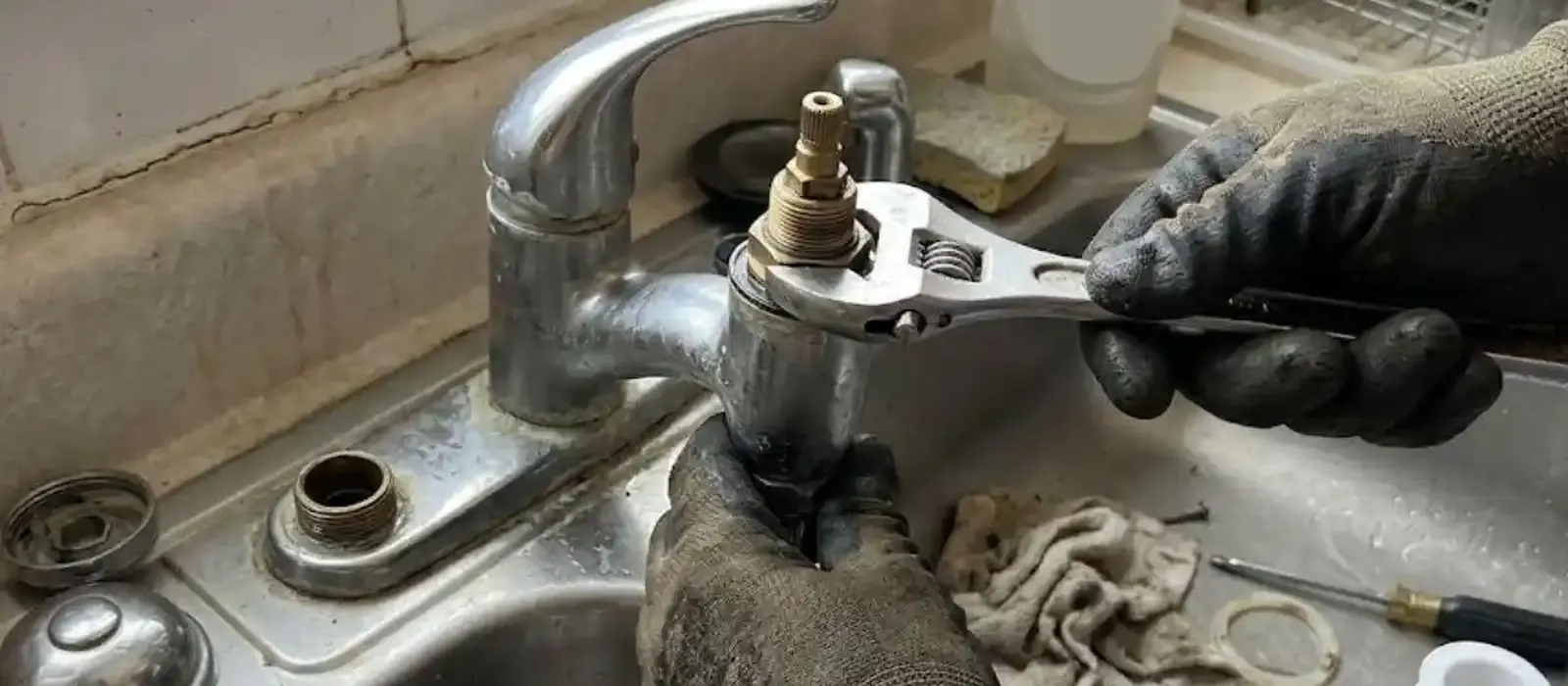
Find where it leaks first
A kitchen faucet can leak from the spout, the handle, the base or the supply lines underneath. The repair depends on the location, so look closely before you buy parts. Dry the faucet and the sink with a towel, then run the water and watch where the first drop appears.
If water is pouring from the base or under the sink and you cannot stop it, close the two small valves under the sink and call. See faucet and fixture repair for how we handle it. If it is a slow drip, read on.
Match the leak to the part
Most leaks trace to one of a few parts.
| Where it leaks | Likely part | Fix. |
|---|---|---|
| Drips from the spout when off | Cartridge or seats and springs | Replace the cartridge or seats. |
| Leaks around the handle | O-ring or packing nut | Replace the O-ring or tighten the nut. |
| Leaks at the base of the spout | Worn spout O-rings | Replace the spout O-rings. |
| Water under the sink | Supply line or connection | Tighten or replace the line. |
| Leaks from the sprayer hose | Hose connection or crack | Replace the hose. |
| Weak flow with dripping | Clogged aerator | Clean the aerator. |
Replacing a cartridge
Close the shutoff valves under the sink and open the faucet to release pressure. Pop off the handle cap, remove the screw and lift the handle off. Unscrew the retaining nut or clip and pull out the cartridge, noting its orientation. Take the old cartridge to a hardware store or order a match using the faucet's brand and model.
Slide in the new cartridge in the same orientation, secure it, replace the handle and open the valves slowly. Check for leaks and test hot and cold. If the handle feels stiff or the water runs in the wrong temperature, the cartridge may be turned 180 degrees.
Replacing O-rings on a swivel spout
Many kitchen faucets have a spout that swivels, sealed by two or more O-rings. When they wear, water seeps out at the base. Remove the spout by loosening a set screw or a retaining nut, lift it off and slide the old rings off. Coat the new rings lightly in plumber's grease and slide them on.
Match the size of the rings carefully. A ring that is a little too large will bunch up and leak, and one that is too small will not seal. Take the old one to the store. A kit made for your faucet model is a safer choice.
Leaks under the sink
The supply lines under the sink are flexible hoses that connect the faucet to the shutoff valves. They wear out, especially older rubber ones. Tighten the connections by hand and a quarter turn with a wrench, and replace any hose that is cracked, bulging or rusty at the fitting. A braided stainless hose is a good upgrade.
If the leak is at the shutoff valve stem, the valve itself needs replacing. A shutoff that will not close or leaks when moved is overdue. We replace them with quarter turn valves. If you cannot stop the water, close the main and call.
What the code says about leak repairs
According to the Massachusetts plumbing and gas code, 248 CMR, the repair of leaks in faucets or valves is exempt from the permit requirement. That covers the cartridge, the O-rings and the stem work in this guide. It does not cover installing a new faucet connected to altered piping, which is plumbing work that may need a permit through the local inspector.
In Hudson, the Building Department at 78 Main Street is the contact if you are unsure. For a simple cartridge swap, you do not need a permit. For moving the sink, adding lines or changing drains, ask first. The distinction matters, because unpermitted alterations can come up when you sell.
Repair or replace the faucet
A faucet that is more than ten or fifteen years old with a worn finish, a cracked body or parts that are no longer made is worth replacing. A new faucet costs more than a cartridge, but it also fixes the finish and the flow. If the parts are easy to find and the faucet is in good shape, repair it.
Consider the whole sink area when you replace. A new faucet is a good time to replace supply lines and shutoff valves. We can supply the faucet or install the one you bought. Homeowners in Stow and Berlin, where private well water can leave mineral deposits, often replace the aerator and the cartridge together.
Tools and parts to have on hand
You will want an adjustable wrench, a screwdriver set, a hex key set, a small pick for O-rings, plumber's grease and a flashlight. A bucket and a towel under the sink save a mess. Have the faucet model number ready, which is often stamped on the underside or inside the cabinet.
Take photos as you disassemble. They are the easiest way to remember how the parts go back together.
Pull-down sprayers and side sprays
A pull-down or side spray has its own hose and connection. If it drips from the head, the diverter or the sprayer washer may be worn. If it leaks under the sink, check the quick connect at the hose and the weight that keeps it from catching.
These parts are often sold as kits for the faucet brand. If the hose is cracked or the head will not retract, replace the hose assembly. It is a quick fix and prevents a leak from soaking the cabinet.
Water damage under the sink
If the cabinet floor is soft, swollen or stained, the leak has been going for a while. Dry it out, replace the damaged board and check for mold. Put a small tray or a leak alarm under the sink to catch the next one early. A cheap alarm gives a warning before the damage spreads.
A short prevention list
Clean the aerator every few months to keep flow strong and minerals from building up. Do not force a handle that is stiff. Replace supply lines every several years. Turn the shutoff valves once a year so they do not seize.
If you have a leak you cannot fix, call. A drip wastes water and a hidden one can rot the cabinet. See leak detection if the water appears but you cannot find the source.
Leaking kitchen faucet questions
The cartridge or the seats and springs are worn. Replacing them usually fixes it.
Often yes. A cartridge or O-ring swap is a common homeowner repair.
No. The state code exempts repairing leaks in faucets or valves. Altering piping or moving a sink may need one.
Use the brand and model number, or take the old cartridge to the store.
The spout O-rings are likely worn. Replace them with a kit made for your faucet.
When the finish is worn, the body is cracked or parts are unavailable.
Plumbing problem right now?
Call the 24/7 line. Dispatch tells you what to do first and sends a technician.