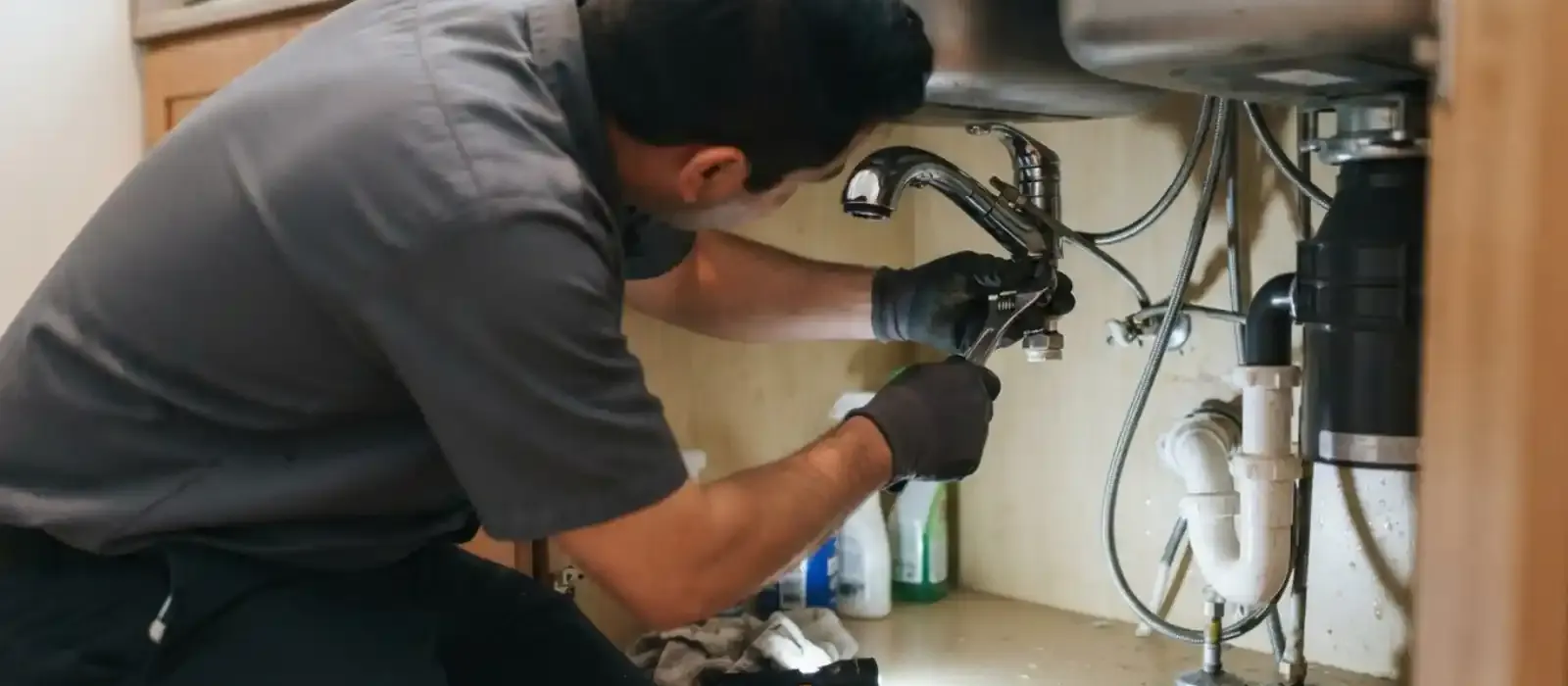
The basic layout
A double kitchen sink has two basins, each with its own strainer and tailpiece. The two tailpieces join at a tee fitting, called a continuous waste, and the tee drains through a single trap to the wall. From the trap the drain runs into a vented branch of the house drain. This is the standard arrangement, and it works when each part is the right size and slopes correctly.
Most trouble comes from a few predictable errors: a trap that sits too low, a horizontal run that is too long or has too little slope and a vent that is missing. We explain each below. If you are planning a larger kitchen project, see plumbing installation for what a full rough-in includes.
Parts you need
Make a list before you start so you buy the right diameter.
- Two basket strainers with gaskets and lock nuts, set in plumber's putty or silicone.
- Two tailpieces, usually one and a half inches in diameter, cut to length.
- A continuous waste tee that joins the two tailpieces, or a center outlet kit for different depth basins.
- A P-trap with a wall arm, or a trap adapter to match the wall stub.
- Slip nuts and washers for each joint, and a spare set in case one cracks.
- A dishwasher tailpiece or a disposal if either is part of the sink.
Step by step
Set the strainers first. Press a ring of putty under each flange, set it in the drain hole, and tighten the nut from below until putty squeezes out. Wipe the excess. Attach the tailpieces to the strainers with their slip nuts.
Then connect the tailpieces to the continuous waste. If the two basins are different depths, the tee goes under the shallower side and the longer tailpiece reaches down. Dry fit the parts first and adjust the trap so the horizontal run slopes gently toward the wall.
Finally, tighten each slip nut by hand and add a quarter turn with pliers. Do not overtighten plastic. Run water in both basins at once and look for drips. Fill one basin and release it while the other is empty to test how the line handles a surge.
Trap, slope and venting
The trap holds water that blocks sewer gas. It needs a vent so that it does not siphon dry. A sink that gurgles when it drains is often an unvented or partly clogged vent. A horizontal run that is too long can also cause siphoning. The code limits how far a trap can sit from its vent, and the limit depends on the pipe diameter.
If you are moving a sink to an island, you will need an island vent or an approved air admittance valve where the code allows. Plan for this before the cabinets are ordered, since it affects the cabinet layout and the floor.
Disposal and dishwasher connections
If one basin has a disposal, its outlet connects to the continuous waste tee by a short horizontal arm. The dishwasher drain hose connects to the disposal inlet or to a tailpiece branch, with a high loop under the counter so that dirty water cannot flow back. Without the loop, the dishwasher can fill with sink water.
Some local codes require an air gap at the sink deck. In Massachusetts the plumbing code sets the rules. If you are unsure, ask a plumber to confirm what your kitchen needs before the countertop goes in.
Common leaks and how to fix them
Most leaks come from the same few places.
| Where it leaks | Cause | Fix. |
|---|---|---|
| Under the strainer flange | Thin or missing putty | Remove, re-putty and tighten. |
| At a slip nut | Cross threaded, cracked washer | Replace the washer and re-seat. |
| At the trap bottom | Loose connection or corrosion | Tighten or replace the trap. |
| At the wall arm | Wrong washer or worn pipe | Replace the arm washer. |
| Under the sink after the dishwasher runs | Loose hose clamp | Tighten the clamp. |
What the code expects for new or altered drains
The Massachusetts plumbing and gas code is 248 CMR. It says plumbing work may not be installed or altered until the inspector issues a permit. Work generally cannot be covered until it has been tested and certified. Exempt work includes repairing leaks in faucets or valves and clearing stoppages, which covers a simple leaky slip nut but not a new drain layout.
In Hudson, that inspector sits in the Building Department at 78 Main Street. If you are moving a sink, adding a second sink or changing the vent, ask whether a permit is required. A licensed plumber pulls it. The reason this matters at the kitchen counter is practical. An inspector will look at the vent and the slope, which are the two things that cause gurgling and slow drains.
When the sink drains slowly after install
A slow double sink after a clean install usually means a flat run, a partial blockage downstream or a missing vent. If only the new sink is slow, check the trap and the slope. If the whole kitchen is slow, the line behind the wall is the issue, and a cable machine may clear it. See drain cleaning.
We have seen new sinks installed over an old line that was already half clogged with grease. The new sink looked fine for a week and then backed up. A camera or a cable pass before the sink goes in prevents that. Customers in Marlborough and Stow book the same check.
Material choices for traps and tailpieces
Most kitchen traps are plastic, usually polypropylene. They are inexpensive, resist corrosion and are easy to cut and adjust. Chrome plated brass is more durable and has a cleaner look under an open cabinet, but it costs more and the slip joints can corrode over time.
If you have a disposal, use a trap that is compatible with its outlet. If the sink is in a cabinet with a shelf, choose a trap that leaves room to reach the joints. A trap you cannot reach will not get cleaned.
Planning for a future dishwasher or disposal
If you do not have a disposal or a dishwasher now, you may want one later. Install the continuous waste with an extra branch or a spare outlet. A knockout in the disposal is easy to open later, and a capped branch on the tee saves cutting pipe.
It is cheaper to plan now than to open the cabinet again. We label the branches and leave notes with the homeowner.
A short checklist before you close the cabinet
Run both faucets and the disposal together. Open the dishwasher and run a drain cycle. Check every joint with a dry paper towel. Test the drain after a few minutes and again the next day. Mark the shutoff valves so you can find them in an emergency.
If anything drips, fix it now. A small weep under a sink goes unnoticed for months and can rot the cabinet floor. It is cheaper to fix a loose nut than a ruined base cabinet.
Double kitchen sink plumbing questions
Usually no. The basins join at a continuous waste tee and share one trap. Some codes allow two traps, but one is standard.
The vent may be blocked or missing, or the drain may be partly clogged. Gurgling means air is being pulled through the trap.
Yes. One basin gets the disposal and its outlet connects to the continuous waste. See our disposal install guide for the steps.
Moving or altering drains and vents generally needs a permit through the Building Department. A simple leak repair does not.
Most use one and a half inch pipe. Check your wall stub and match it.
The dishwasher drain hose is missing a high loop or the line is clogged. Fix the loop first.
Plumbing problem right now?
Call the 24/7 line. Dispatch tells you what to do first and sends a technician.